Preventive Maintenance Guide
for the Red Seal Millwright Exam
Preventive and predictive maintenance strategies, inspection techniques, vibration analysis, oil analysis, and maintenance planning explained for the Red Seal Millwright exam.
Maintenance Is the Core of the Millwright Trade
Installation gets the equipment running. Maintenance keeps it running. The Red Seal exam reflects this — a significant portion of the NOA is dedicated to maintenance knowledge, and maintenance questions appear across every block.
A millwright who understands why maintenance tasks are performed — not just how — will answer these questions correctly because the reasoning follows from the principles.
Maintenance Strategies
There are four fundamental approaches to maintenance. The exam tests whether you can identify which strategy is being used and when each is appropriate.
Reactive Maintenance (Run to Failure)
Equipment is operated until it fails, then repaired or replaced. No planned maintenance is performed.
When it is appropriate:
- Non-critical equipment where failure has no safety consequence
- Equipment that is inexpensive and easy to replace
- Equipment where failure is random and unpredictable regardless of maintenance effort
- Where the cost of maintaining exceeds the cost of replacing
Disadvantages:
- Unplanned downtime — failures occur at the worst possible time
- Secondary damage — a bearing failure that is allowed to run destroys the shaft, housing, and surrounding equipment
- Safety risk — some failures are hazardous
EXAM TIP
Run-to-failure is a deliberate maintenance strategy, not a failure of maintenance planning. The exam may describe a scenario and ask which strategy is being applied — recognize that running cheap, non-critical equipment to failure is sometimes the correct decision.
Preventive Maintenance (Time-Based)
Maintenance tasks are performed on a fixed schedule — calendar time or operating hours — regardless of equipment condition.
Examples:
- Change gearbox oil every 2,000 operating hours
- Regrease bearings every 500 hours
- Inspect coupling every 6 months
- Replace V-belts annually
Advantages:
- Simple to plan and schedule
- Reduces unexpected failures
- Satisfies OEM warranty requirements
Disadvantages:
- May replace components that still have useful life remaining — wasteful
- May miss failures that develop between scheduled intervals
- Does not account for actual equipment condition — a bearing that was incorrectly installed will fail before its scheduled service interval regardless of the schedule
Predictive Maintenance (Condition-Based)
Maintenance is performed based on the actual condition of the equipment, monitored through ongoing measurement and analysis. Tasks are triggered by condition — not by a calendar.
Condition monitoring tools:
- Vibration analysis
- Oil analysis
- Thermography (infrared)
- Ultrasonic detection
- Motor current analysis
Advantages:
- Maintenance performed only when needed — maximum component life
- Failure is detected before it occurs — planned repair instead of emergency breakdown
- Reduces unnecessary maintenance costs
Disadvantages:
- Requires investment in monitoring equipment and trained personnel
- Requires baseline data to compare against — new equipment must be monitored from installation to establish normal readings
Reliability-Centered Maintenance (RCM)
A systematic approach that determines the most appropriate maintenance strategy for each failure mode of each component. RCM asks: what does this component do, how can it fail, what are the consequences of failure, and what maintenance task — if any — prevents that failure?
The result is a maintenance plan that uses the right strategy (reactive, preventive, or predictive) for each failure mode rather than applying one strategy to everything.
EXAM TIP
RCM is the strategic framework behind modern industrial maintenance programs. The exam tests the concept and the language — failure modes, failure consequences, and maintenance task selection. You do not need to perform an RCM analysis, but you need to recognize and describe the approach.
Condition Monitoring Techniques
Vibration Analysis
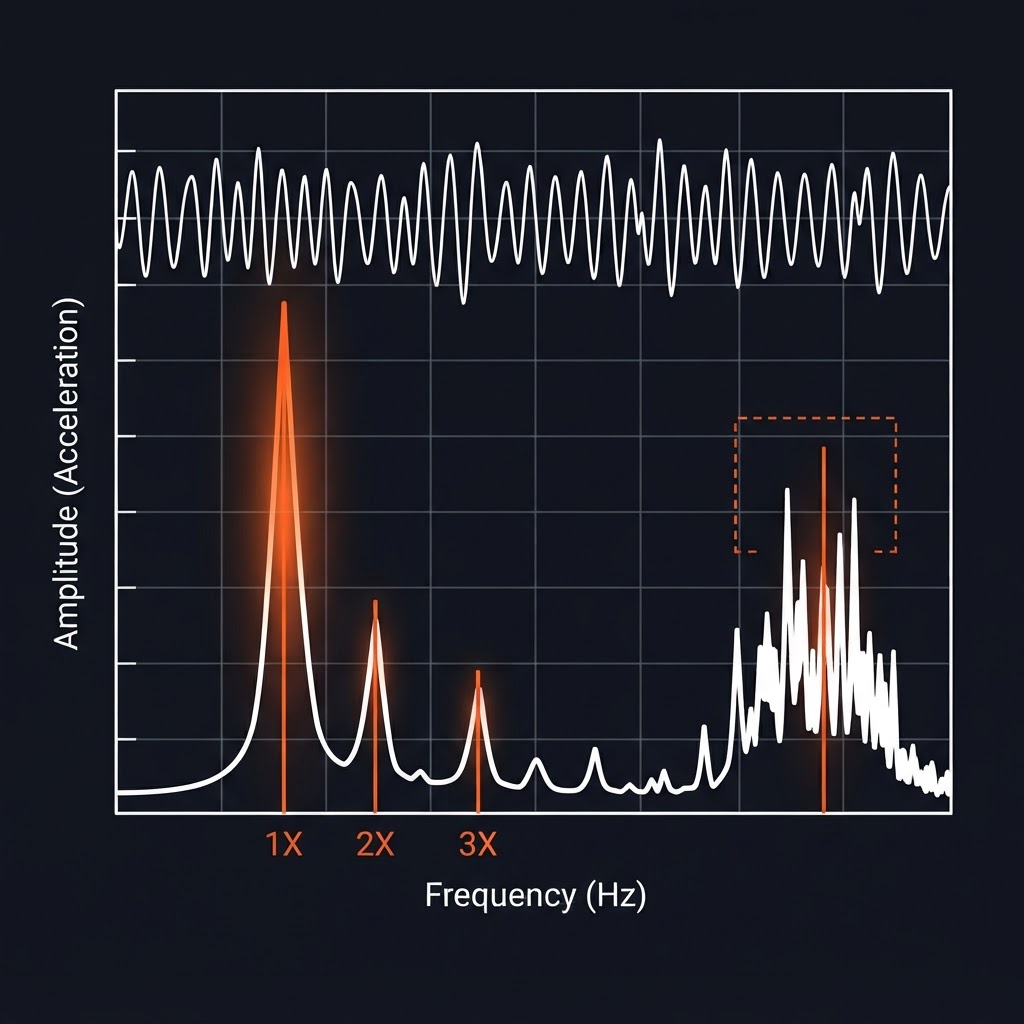
Machinery vibration carries information about the mechanical condition of rotating components. Vibration analysis is one of the most powerful predictive maintenance tools available to millwrights.
Frequency
How many cycles per second (Hz) or cycles per minute (CPM). Frequency identifies the source of vibration.
Amplitude
The magnitude of the vibration. Amplitude indicates severity.
Phase
The timing relationship between vibration signals. Phase helps distinguish between different fault types.
Common vibration frequencies and their sources:
| Frequency | Likely Source |
|---|---|
| 1× running speed (1X) | Imbalance, misalignment, bent shaft |
| 2× running speed (2X) | Misalignment (especially angular), looseness |
| Sub-synchronous (less than 1X) | Oil whirl in journal bearings, instability |
| High frequency (many X) | Bearing defects, gear mesh, cavitation |
| Electrical frequency (1× or 2× line frequency) | Motor electrical fault |
Imbalance
A mass asymmetry in a rotating component produces a centrifugal force at 1× running speed in the radial direction. Corrected by adding or removing mass at the correct angular location — dynamic balancing.
Misalignment
Produces vibration predominantly at 1X and 2X running speed. Axial vibration is a strong indicator of angular misalignment.
Bearing Defects
Rolling element bearings produce characteristic defect frequencies as damage develops on the inner race, outer race, rolling elements, or cage. These frequencies are calculated from bearing geometry and running speed.
Overall Vibration Levels
Measured in mm/s RMS velocity. ISO 10816 provides vibration severity guidelines based on machine class and foundation type. Know that increasing overall vibration level is a warning sign — a sudden jump in vibration is more significant than a gradual increase at the same level.
EXAM TIP
A machine showing high vibration at 1× running speed has an imbalance or misalignment issue. High vibration at 2× is strongly associated with misalignment. The exam will give a vibration frequency and ask for the likely source.
Oil Analysis
A laboratory technique that evaluates the condition of the lubricant and detects wear debris and contamination. A small sample is taken from the equipment and sent for analysis.

Wear Metals
| Metal | Source |
|---|---|
| Iron | Gears, shafts, rings |
| Copper / Tin | Bronze bushings, bearing cages |
| Aluminum | Pistons, housings |
| Lead / Tin | Plain bearing material (babbitt) |
| Silicon | Dirt contamination (not a wear metal, but a contamination indicator) |
Lubricant Condition
Viscosity
Has the oil thinned (dilution, degradation) or thickened (oxidation, contamination)?
Acid Number (AN) / Base Number (BN)
Indicates oxidation and additive depletion
Water Content
Detected by Karl Fischer titration or crackle test
Oxidation and Nitration Products
By-products of oil breakdown at elevated temperatures
Particle Count (ISO 4406)
Quantifies the number of particles per millilitre at defined size ranges. Critical for hydraulic systems where particle contamination causes valve and pump wear.
EXAM TIP
A sudden increase in copper in a gearbox oil sample indicates bronze bushing or bearing cage wear. Iron particles indicate gear or shaft wear. Silicon indicates dirt ingestion — check seals and breathers.
Infrared Thermography
An infrared camera detects heat — areas of elevated temperature indicate electrical resistance, friction, insulation breakdown, or blocked flow.
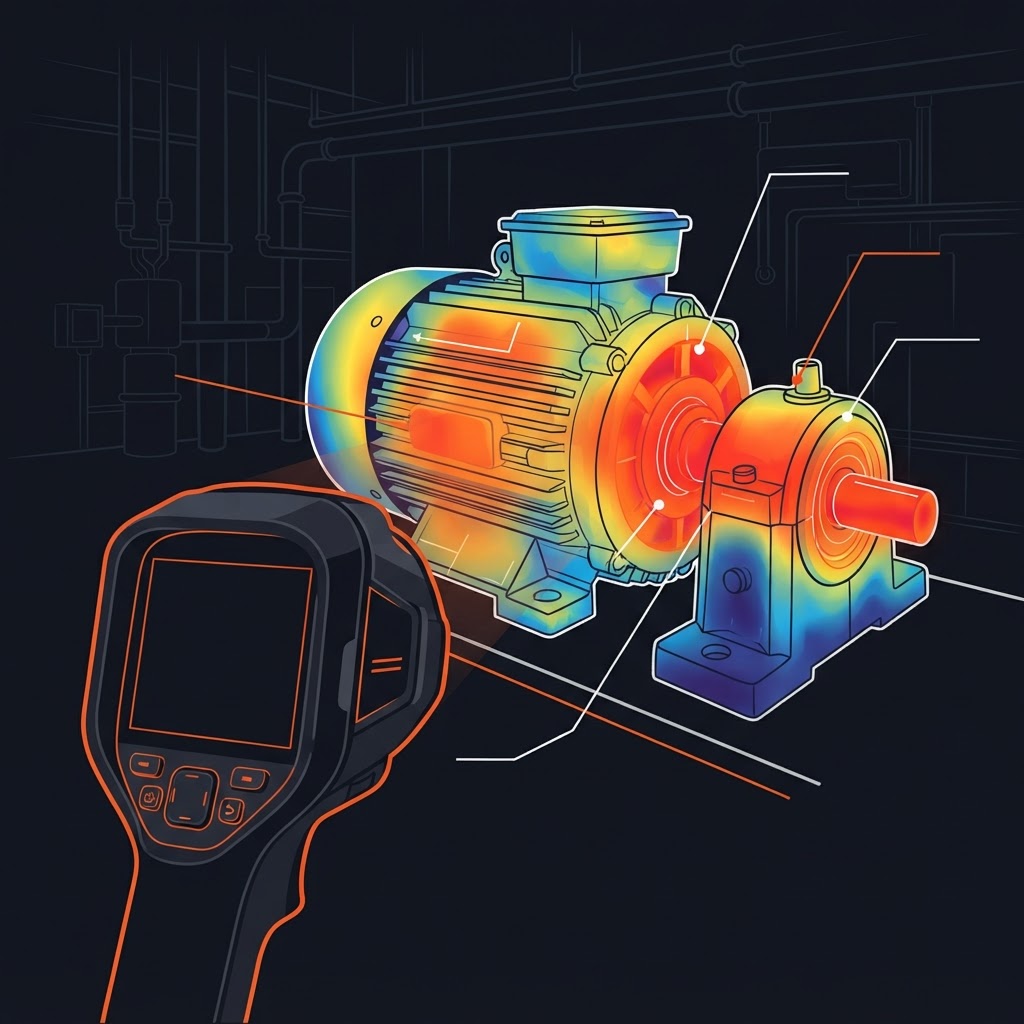
Applications:
- Bearing condition — a hot bearing is a failing bearing
- Coupling condition — a hot coupling indicates misalignment or inadequate lubrication
- Electrical connections — loose connections create resistance and heat
- Steam traps — thermography identifies failed-open and failed-closed traps
- Refractory and insulation — heat loss through damaged insulation
EXAM TIP
Thermography is a non-contact, non-invasive technique — equipment does not need to be shut down for inspection. It detects the symptom (heat) rather than the cause — follow-up investigation is always required to identify why the component is running hot.
Ultrasonic Detection
High-frequency sound (ultrasound) is used to detect bearing defects, air/steam/gas leaks, electrical discharge, and lubrication condition.
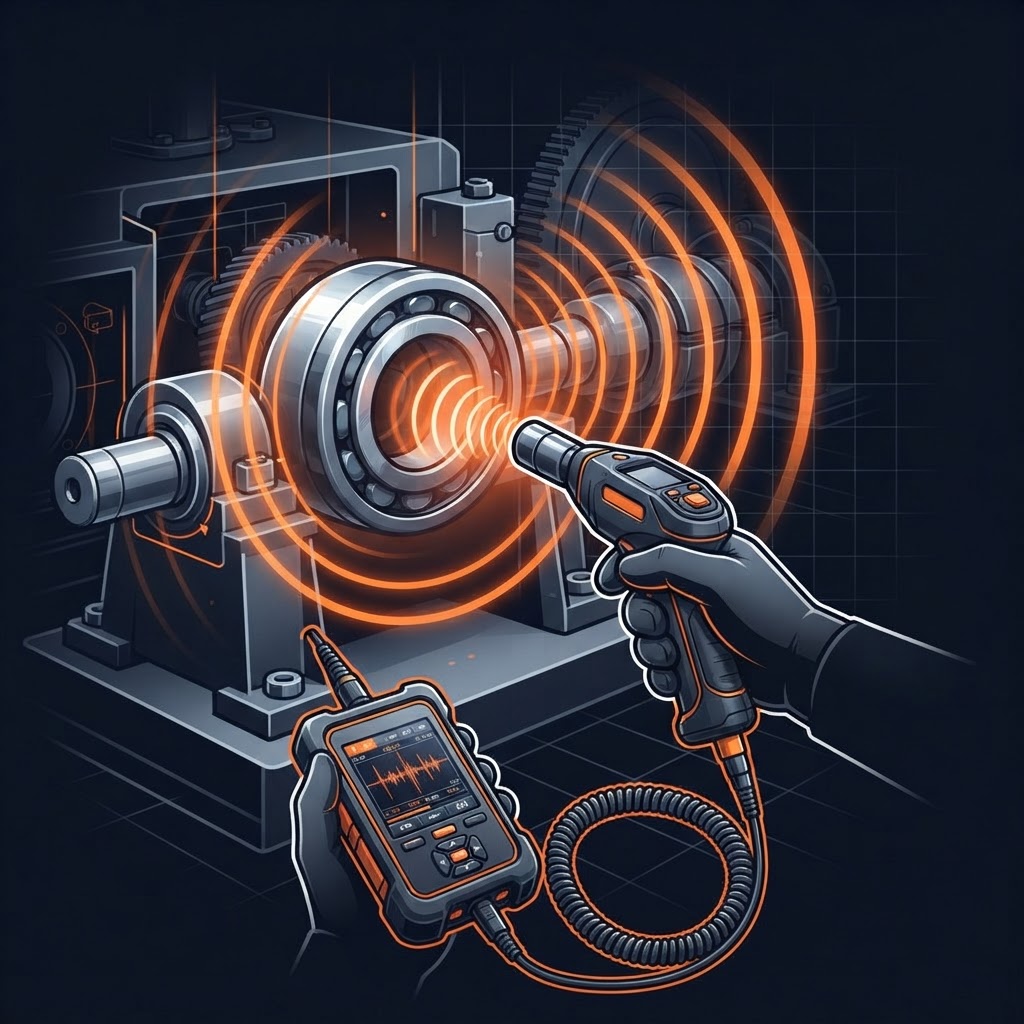
Applications:
- Bearing defects — early-stage bearing damage produces high-frequency noise before it appears in standard vibration analysis
- Air, steam, and gas leaks — turbulent flow at a leak point generates ultrasound
- Electrical discharge (arcing, corona, tracking) — electrical faults produce ultrasonic signatures
- Lubrication condition — an under-lubricated bearing produces high-frequency friction noise that decreases when lubrication is adequate
EXAM TIP
Ultrasonic detection is particularly valuable for detecting bearing defects at an earlier stage than vibration analysis. It is also the preferred tool for locating compressed air leaks — a significant energy waste in many industrial facilities.
Motor Current Signature Analysis (MCSA)
Analyzes the current drawn by an electric motor to detect mechanical and electrical faults. Current variations caused by load fluctuations (a damaged gear tooth, a worn pump impeller, broken rotor bars) produce characteristic frequencies in the current spectrum.
Applications:
- Broken or cracked rotor bars
- Eccentricity (air gap variation)
- Load-related mechanical faults
Non-invasive — analysis is performed at the motor control panel without accessing rotating equipment.
Planned Maintenance Tasks
Inspection
Systematic visual and physical examination of equipment — the foundation of any maintenance program.
- Leaks — oil, fluid, air, or process fluid at seals, joints, and fittings
- Unusual noise — rattling, knocking, squealing, or changes from normal operating sound
- Vibration — unusual or increased vibration felt by hand or observed visually
- Temperature — components that are hotter than normal to the touch or by thermometer
- Wear — visible wear on belts, chains, couplings, and exposed components
- Fastener condition — loose, missing, or corroded fasteners
- Guard and safety device condition — missing or damaged guards must be reported immediately
Inspection frequency is based on equipment criticality, operating environment, and history. Critical equipment in harsh environments requires more frequent inspection.
Lubrication
Covered in detail in the Lubrication Guide — key preventive maintenance points:
- Follow OEM lubrication specifications — correct lubricant, correct quantity, correct interval
- Document all lubrication tasks — date, lubricant used, quantity, and condition observations
- Do not mix lubricants unless compatibility is confirmed
- Check oil levels at the correct time (equipment at rest, oil at operating temperature where specified)
- Inspect oil condition during level checks — milky appearance, metallic smell, or visible particles indicate a problem
Belt and Chain Inspection and Tensioning
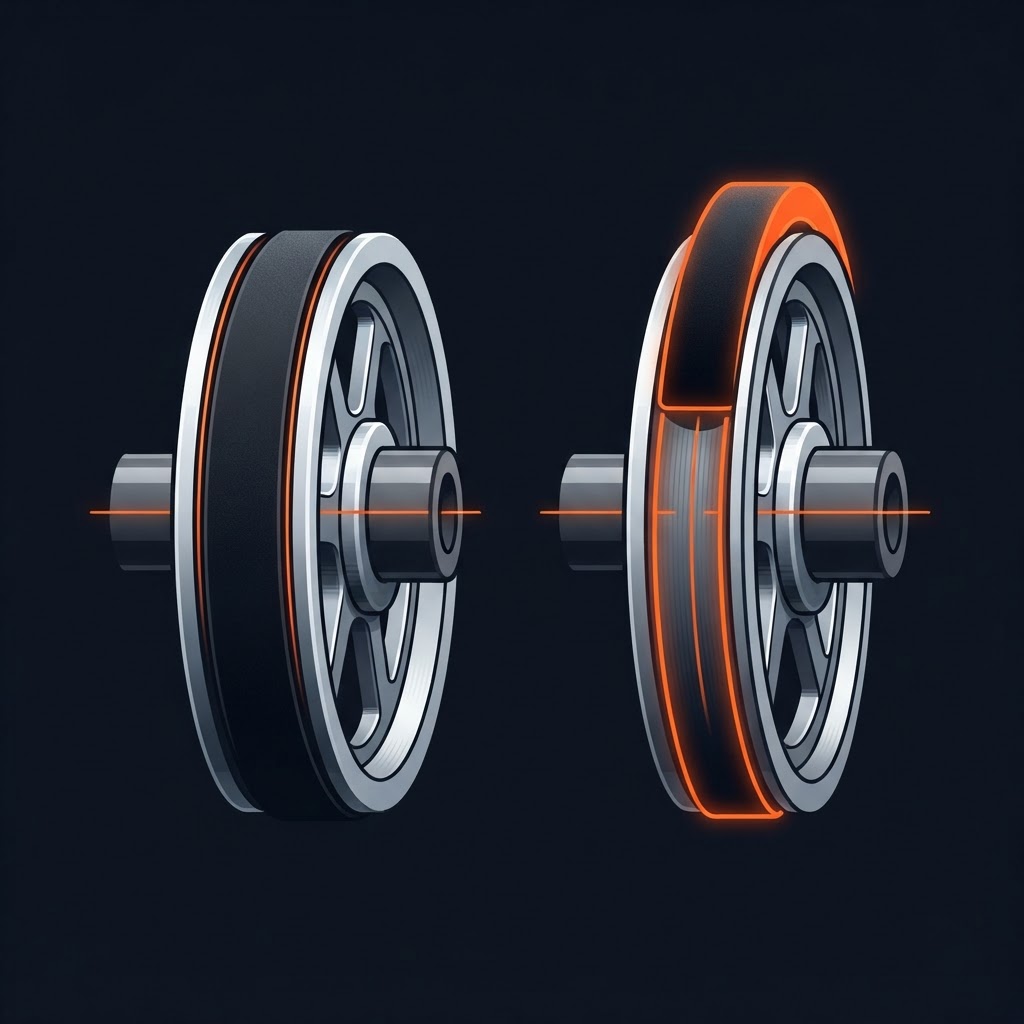
V-belt inspection
- Check for cracking, fraying, glazing, and oil contamination
- Check belt seating in the sheave groove — belts riding on the top of the groove indicate worn sheaves or incorrect belt cross-section
- Check sheave alignment — misaligned sheaves cause rapid belt wear and side loading
- Tension using deflection method or tensionmeter — correct tension is critical: too loose causes slipping and heat, too tight causes bearing overload
Chain inspection
- Check for elongation (stretch) — measure a known number of links against the original pitch length. Chains worn beyond 3% elongation should be replaced
- Check for tight links, corrosion, and side plate cracking
- Check sprocket wear — hooked tooth profiles indicate advanced sprocket wear; replace chain and sprockets together
- Lubrication — chains require consistent lubrication. Dry chains wear rapidly and generate heat
Coupling Inspection
- Inspect elastomeric elements (spider, disc pack, grid) for cracking, compression, or extrusion
- Check coupling alignment — refer to Shaft Alignment and Couplings guides
- Check fastener torque on flanged and disc couplings
- Inspect gear couplings for tooth wear and lubrication condition
Filter and Strainer Maintenance
- Replace or clean filters on schedule — a clogged filter bypasses and allows unfiltered fluid into the system
- Note differential pressure across filters — increasing differential pressure indicates the filter is loading up and approaching bypass
- Inspect filter element on removal — the type and quantity of debris collected indicates what is happening in the system
- Clean magnetic drain plugs at each oil change — metal particles collected indicate wear
Maintenance Documentation
Documentation is not paperwork for its own sake — it is the data that makes maintenance decisions possible.
Work Orders
A work order records:
- What equipment was worked on (asset ID, location)
- What work was performed
- What parts were used
- How long the work took
- What was found during inspection
- What follow-up work is required
Equipment History
The maintenance history of a piece of equipment reveals patterns:
- Recurring failures indicate a root cause that hasn't been addressed
- Increasing failure frequency indicates end of service life approaching
- A history of correct lubrication and alignment correlates with longer component life
Mean Time Between Failures (MTBF)
MTBF is the average time between failures for a repairable component or system. Calculated as total operating time divided by number of failures. A decreasing MTBF indicates a deteriorating situation. An increasing MTBF following a maintenance change indicates the change was effective.
Mean Time To Repair (MTTR)
The average time required to repair a failed component. MTTR is a measure of maintenance efficiency and spare parts availability.
EXAM TIP
MTBF and MTTR are key metrics in any maintenance program. Higher MTBF and lower MTTR are the goals. The exam may ask for a calculation or ask what it means when one of these metrics changes.
Root Cause Analysis (RCA)
Root cause analysis investigates failures to find the underlying cause — not just the immediate cause — so the failure can be prevented from recurring.
The 5 Whys Technique
Ask "why" five times, with each answer forming the basis for the next question:
Why did the bearing fail?
Because it overheated
Why did it overheat?
Because lubrication was insufficient
Why was lubrication insufficient?
Because the grease interval was too long
Why was the interval too long?
Because the OEM recommendation wasn't followed during commissioning
Why wasn't it followed?
Because the maintenance schedule was set up without referencing OEM documentation
Root Cause
Maintenance schedule established without OEM documentation.
Corrective Action
Review all PM intervals against OEM specifications.
EXAM TIP
The 5 Whys is a simple but effective RCA tool. The exam may describe a failure scenario and ask for the root cause — practice looking past the immediate failure to the underlying condition that allowed it to happen.
Maintenance Planning and Scheduling
Critical Path
The sequence of tasks that determines the total duration of a maintenance shutdown. Tasks on the critical path cannot be delayed without extending the total outage time.
Spare Parts Management
Critical spare parts must be on hand before a planned shutdown begins. Waiting for parts during a shutdown extends downtime.
Permit Systems
Maintenance work on industrial equipment requires permits:
Lockout/Tagout
For work on energy-isolated equipment (covered in Safety Guide)
Hot Work Permit
For welding, cutting, or grinding in areas with flammable materials
Confined Space Entry Permit
For work inside vessels, tanks, and enclosed spaces
Line Break Permit
For opening pressurized or hazardous fluid systems
EXAM TIP
Working without the required permit is a serious safety violation. The exam will test whether you know which permit applies to which type of work.
Failure Mode Analysis
Understanding common failure modes for mechanical components helps a millwright both prevent failures and diagnose them quickly when they occur.
Bearing Failure Modes
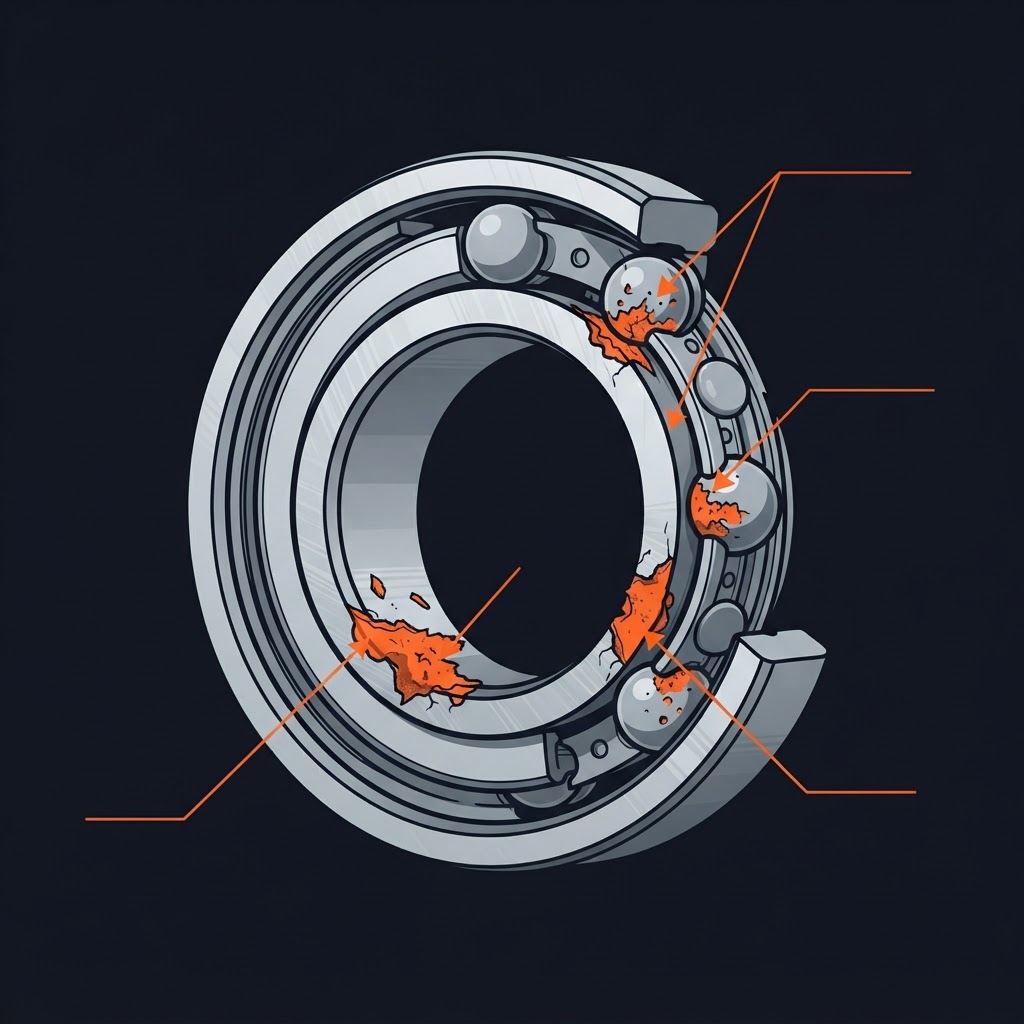
| Failure Mode | Cause | Prevention |
|---|---|---|
| Fatigue spalling | Normal end of life, overload, contamination | Correct loading, clean lubricant |
| Corrosion pitting | Water or chemical contamination | Sealed housings, correct lubricant |
| Abrasive wear | Particle contamination | Filtration, clean installation |
| Adhesive wear (smearing) | Inadequate lubrication, slide/roll ratio too high | Correct lubricant, avoid shock loads |
| Fretting corrosion | Loose fit — micromotion between bearing and seat | Correct interference fit |
| Electric fluting | Stray electrical current through bearing | Insulated bearings, proper grounding |
Seal Failure Modes
Covered in detail in the Pumps Guide — key points:
- Most seal failures are installation-related
- Dry running destroys seal faces rapidly
- Chemical incompatibility degrades secondary seals (O-rings)
Fastener Failure Modes
| Failure Mode | Cause | Prevention |
|---|---|---|
| Loosening | Vibration, thermal cycling, inadequate preload | Correct torque, thread locking compounds where specified, lock washers or prevailing torque nuts |
| Fatigue fracture | Cyclic loading, stress concentration at thread root | Correct preload, fatigue-rated fasteners for dynamic applications |
| Corrosion | Incorrect fastener material for the environment | Correct material selection (stainless, galvanized, or coated for corrosive environments) |
| Hydrogen embrittlement | High-strength fasteners plated with cadmium or zinc can absorb hydrogen during plating, causing brittle fracture | Baking after plating, correct specification |
Sample Exam-Style Questions
Work through these exam-style scenarios. Tap each to reveal the approach.
A pump bearing has failed three times in the past year, each time within two months of replacement. The maintenance team has been replacing the bearing and returning the pump to service each time. What maintenance approach should be taken and why?
A vibration analysis report shows a significant peak at 2× running speed in the axial direction. What does this indicate?
An oil analysis report on a gearbox shows a significant increase in copper content from the previous sample. What does this indicate and what action should be taken?
A V-belt is found riding on the top of the sheave groove rather than seated in the groove. List two possible causes.
Calculate the MTBF for a conveyor drive that ran for 8,760 hours in one year and experienced three failures.
A millwright is about to open a hydraulic line to replace a fitting. What permit is required and what steps must be completed before the line is opened?
Frequently Asked Questions
Ready to Test Your Maintenance Knowledge?
Preventive maintenance questions appear across every NOA block. The millwright who understands the reasoning behind maintenance tasks — not just the procedure — answers confidently across the whole exam.
Related guides:
Last updated: September 2026 · MW Red Seal Millwright Prep is built by a millwright, for millwrights. Content is aligned with the National Occupational Analysis (NOA) for Industrial Mechanic (Millwright) — the same document that structures the Red Seal exam.